
The Science of 5,895m: Why Your Body Succeeds or Fails on Kilimanjaro
Climbing Mount Kilimanjaro is often described as a “walk-up” mountain because it requires no technical ropes or crampons. However, this description is dangerously misleading. While your legs do the walking, your internal biology is doing the heavy lifting.
The official success rate for reaching Uhuru Peak hovers around 65%. This means that nearly one in three climbers turns back before the summit. Why? It is rarely a lack of leg strength; it is almost always a failure of acclimatization.
In this guide, we break down the science of high altitude to help you understand what actually happens to your body above 3,000 meters.
1. The Oxygen Gap: Atmospheric Pressure vs. Your Lungs
A common misconception is that there is “less oxygen” at the top of Kilimanjaro. In reality, the percentage of oxygen in the air remains constant at about 21%.
The problem is atmospheric pressure. As you climb higher, the air becomes “thinner”—the molecules are spread further apart.
At the summit of Kilimanjaro (5,895m), the pressure is so low that there is effectively 49% less oxygen available per breath than at sea level.
When your lungs take in a breath at 5,000 meters, your blood cannot absorb oxygen as efficiently. This leads to Hypoxia (low oxygen in the tissues), the root cause of altitude-related challenges.
2. Red Blood Cell Factory: How Your Body Adapts
Your body is an incredible machine, but it is a slow one. To survive at the summit, your body must undergo a process called acclimatization.
When your brain detects lower oxygen levels, it triggers a hormone called erythropoietin (EPO). This tells your bone marrow to start producing more red blood cells. These cells are the “delivery trucks” that carry oxygen to your muscles and brain.
The Catch: Your body cannot produce these cells overnight. It takes days for the new cells to mature and begin circulating.
The Lesson: This is why “fit” people often fail. You can have the strongest heart in the world, but if you haven’t given your bone marrow enough days to build your “delivery fleet,” your muscles will eventually starve of oxygen and shut down.
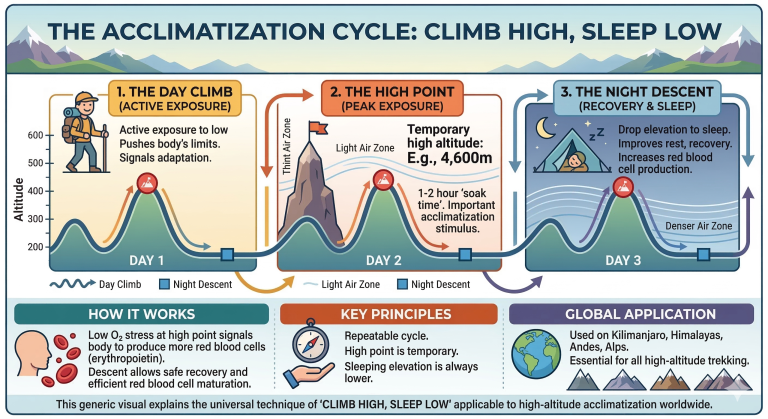
3. The "Climb High, Sleep Low" Strategy
In the world of high-altitude mountaineering, this is the golden rule. But why does it work?
Acclimatization is a “stress and recovery” loop. When you hike up to a high point (like the Lava Tower at 4,630m) and stay there for an hour, you are safely stressing your system. You are telling your brain: “We don’t have enough oxygen here; start the adaptation process!”
By then descending to sleep at a lower camp (like Barranco at 3,900m), you give your body the oxygen-rich environment it needs to actually perform the recovery and build those new red blood cells. Routes that follow this “yo-yo” profile have significantly higher success rates.
4. Why "Pole Pole" is a Medical Necessity
You will hear your guides say “Pole Pole” (Slowly, Slowly) a thousand times. This isn’t just to make the day easier; it is a cardiovascular strategy.
When you hike fast, your heart rate spikes. At high altitude, a high heart rate consumes oxygen faster than your “thinner” blood can replace it. This creates an oxygen debt. If you stay in an oxygen debt for too long, you trigger Acute Mountain Sickness (AMS).
By walking at a pace where you can still hold a full conversation without gasping, you keep your heart rate in the “aerobic zone,” allowing your body to manage the limited oxygen supply effectively.
5. Summary: Choosing Your Window of Success
If you look at the data, the science points to one clear conclusion: Time is your best teammate.
| Duration | Physiological Impact | Success Probability |
| 5 Days | Extreme stress; body cannot adapt fast enough. | Low (approx. 27%) |
| 7 Days | Ideal “Stress/Recovery” cycles for most bodies. | High (approx. 85%) |
| 8-9 Days | Maximum red blood cell production; high energy. | Very High (95%+) |
Kilimanjaro is a test of patience, not power. Understanding the science of your own biology is the first step toward standing on the Roof of Africa. Respect the altitude, listen to the “Pole Pole” rhythm, and give your body the days it needs to win the invisible battle.
About the Author
This article was compiled by the expert guiding team at Eyes on Kilimanjaro. With over a decade of experience on the mountain, our focus is on the safety, science, and success of every climber who steps onto the slopes of Tanzania.
Frequently Asked Questions about Kilimanjaro Altitude
What is the most common reason people fail to summit Kilimanjaro?
The primary reason is Acute Mountain Sickness (AMS). This occurs when a climber ascends too quickly, preventing the body from producing enough red blood cells to handle the decreased atmospheric pressure. Physical fitness is helpful, but it cannot override the biological need for time.
Can I take Diamox (Acetazolamide) to help with acclimatization?
Yes, many climbers use Diamox to help speed up the acclimatization process. It works by acidifying the blood, which stimulates more frequent breathing. However, it is a diuretic and has side effects like tingling fingers. We always recommend consulting with a doctor before your climb.
Does being an athlete make it easier to reach the summit?
Surprisingly, no. High fitness levels can sometimes be a disadvantage because athletes tend to hike too fast (haraka haraka), which spikes the heart rate and leads to faster oxygen depletion. On Kilimanjaro, “slow and steady” biology beats “fast and fit” every time.
Which Kilimanjaro route has the highest success rate?
The 8-Day Lemosho Route and the 9-Day Northern Circuit currently have the highest success rates (over 95%). These routes provide the most “Climb High, Sleep Low” opportunities and give the body the necessary 48–72 hours to complete major physiological shifts.
How do I know if I have altitude sickness or just exhaustion?
Early symptoms of AMS include a persistent headache, loss of appetite, and nausea. Exhaustion usually improves with food and rest, whereas AMS symptoms typically worsen or stay the same until you descend. Professional guides use pulse oximeters to check your oxygen saturation and heart rate to make an objective safety decision.