
The Great Wildbeest Migration - An Eternal Symphony of Survival
The Great Wildebeest Migration is often described as “the greatest show on Earth,” but to the scientific community, it is something far more profound: it is the largest overland animal migration on the planet. This is not a single event, but a relentless, circular quest for water and mineral-rich grass that covers over 3,000 kilometers across the Serengeti-Mara ecosystem.
The Biological Engine: Why They Move
The movement of over 1.5 million wildebeest, accompanied by hundreds of thousands of zebras and gazelles, travel across the vast plains of the Serengeti ecosystem in search of fresh grazing and water.
Rather than being a single event, the migration is a continuous yearly cycle, where the herds move in a large clockwise loop through the Serengeti-Mara ecosystem.
What Drives the Migration?
The animals follow the “Green Wave.” Wildebeest have an uncanny ability to detect rain from over 50 kilometers away. Evolution has equipped them with a “biological compass” that responds to lightning and the scent of rain on the wind, pulling them toward areas where the volcanic soil of the Serengeti has produced nutrient-dense grass.
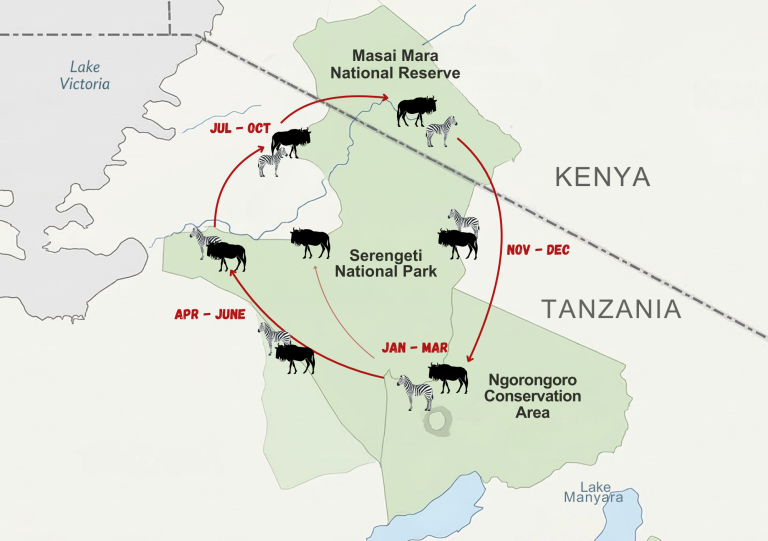
The Seasonal Cycle
1. The Birthing Hub (January – March)
The cycle begins in the Southern Serengeti and the Ndutu Plains. This region is unique because the soil is rich in phosphorus and calcium, essential for milk production in mothers and bone growth in calves.
The Phenomenon: In a synchronized “birthing peak,” approximately 500,000 calves are born within a two-to-three-week window.
The Strategy: By birthing all at once, the herds “swamp” predators. There are simply too many calves for lions and hyenas to eat at once, ensuring a higher survival rate for the majority.
2. The Trek North (April – June)
As the southern plains dry out, the herds move toward the Central Serengeti (Seronera) and the Western Corridor. This is a transitional period where the herds form massive “mega-columns” that can stretch for several kilometers.
3. The River Obstacles (July – August)
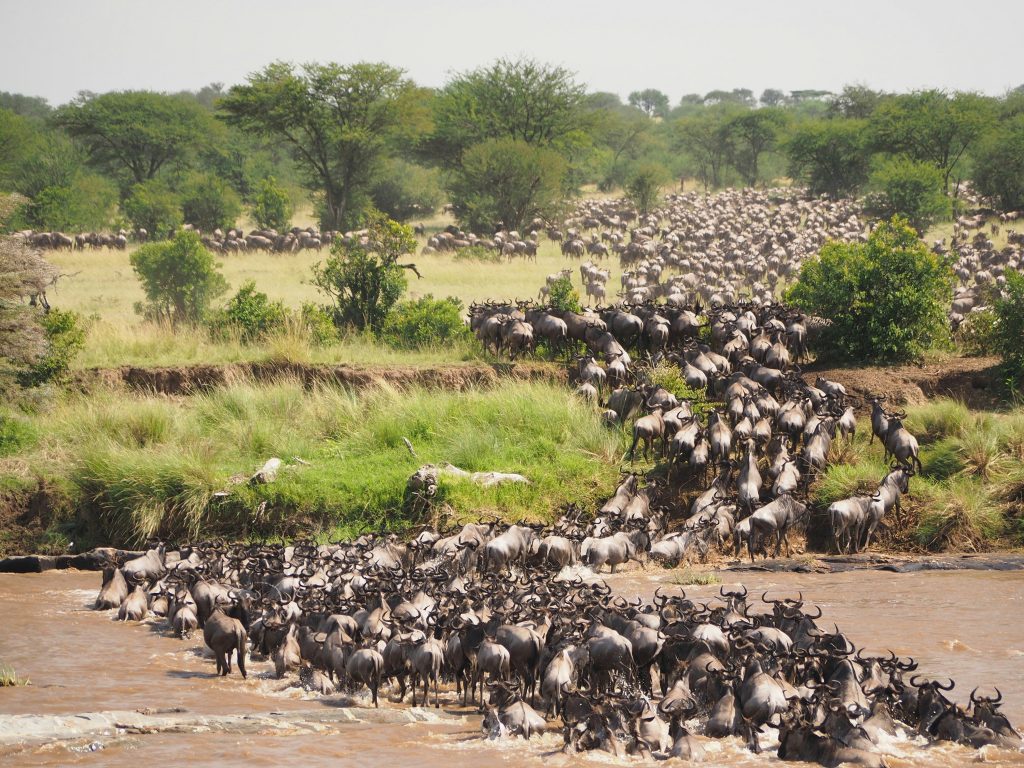
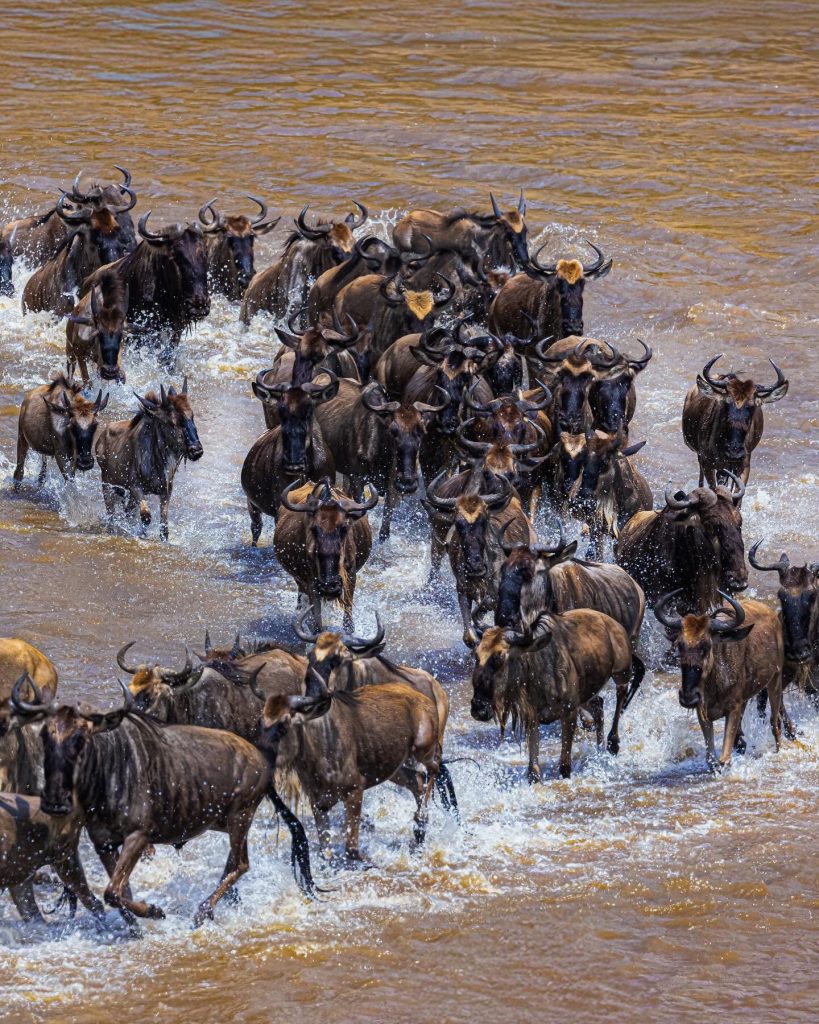
By July, the herds face their most famous challenges: the Grumeti and Mara Rivers.
The Risk: These waters are home to some of Africa’s largest Nile crocodiles.
The Psychology: Wildebeest are “follow-the-leader” animals. They may gather on the banks for days, hesitant to jump, until a single animal takes the leap, triggering a chaotic and spectacular surge of thousands behind it.
4. The Mara Refuge (September – October)
The animals spend these months grazing in the Masai Mara in Kenya. Because the Mara receives more rainfall than the Serengeti, it serves as a critical “dry season refuge.” Without this northern sanctuary, the population would likely collapse during years of drought.
5. The Return South (November – December)
With the onset of the “short rains,” the herds sense the renewal of the southern plains. They move rapidly south through the eastern limits of the Serengeti, completing the loop just as the nutrient-rich grasses of the south begin to sprout again, ready for the next calving season.
When is the Best Time to see the Migration ?
There is no single “best time” — it depends on what you want to see.
Each stage of the migration offers a completely different safari experience.
| Experience | Best Time | Location |
|---|---|---|
| Calving season | Jan – Mar | Southern Serengeti |
| Huge moving herds | Apr – Jun | Central / Western Serengeti |
| River crossings | Jul – Oct | Northern Serengeti |
| Green season safari | Nov – Dec | Central & Southern Serengeti |
Frequently Asked Questions: The Great Migration
When is the best time to see the Great Migration?
The migration is a year-round event, so “the best time” depends on what you want to see. For the calving season, visit between January and March. For the iconic river crossings, the peak window is typically from late July through October.
Does the migration happen in Tanzania or Kenya?
It happens in both. The herds spend the vast majority of the year (roughly nine to ten months) in Tanzania’s Serengeti. They usually spend two to three months (August–October) in Kenya’s Masai Mara before heading back south.
Is the timing of the river crossings guaranteed?
No. The migration is a natural phenomenon driven by rainfall. While we can predict general patterns, the exact dates of river crossings vary every year based on when the rains start and stop.
What is the "Calving Season"?
This occurs in the southern Serengeti (Ndutu) between January and March. It is a period where hundreds of thousands of wildebeest are born. It is an incredible time for photography, as the high concentration of newborns attracts a significant number of predators like lions, cheetahs, and leopards.
Can I see the migration while climbing Mount Kilimanjaro?
Not simultaneously. Mount Kilimanjaro is located roughly 300 kilometers east of the Serengeti. However, most travelers combine the two: completing a 6–8 day trek on Kilimanjaro first, followed by a short bush flight into the Serengeti to witness the migration.
What other animals participate in the migration?
While wildebeest are the primary focus (over 1.5 million), they are accompanied by roughly 200,000 zebras and hundreds of thousands of Thompson’s gazelles and elands. These species coexist because they eat different parts of the same grass.
Is it better to see the migration from a vehicle or a hot air balloon?
Both offer unique perspectives. A 4×4 safari vehicle allows you to get close to the action and witness predator-prey interactions. A hot air balloon at dawn offers a “bird’s-eye view,” revealing the true, massive scale of the columns stretching across the plains.